
How to Pump a Wakesurf Board Without Bouncing or Losing the Wave
October 24, 2026 · By Jordan Miller
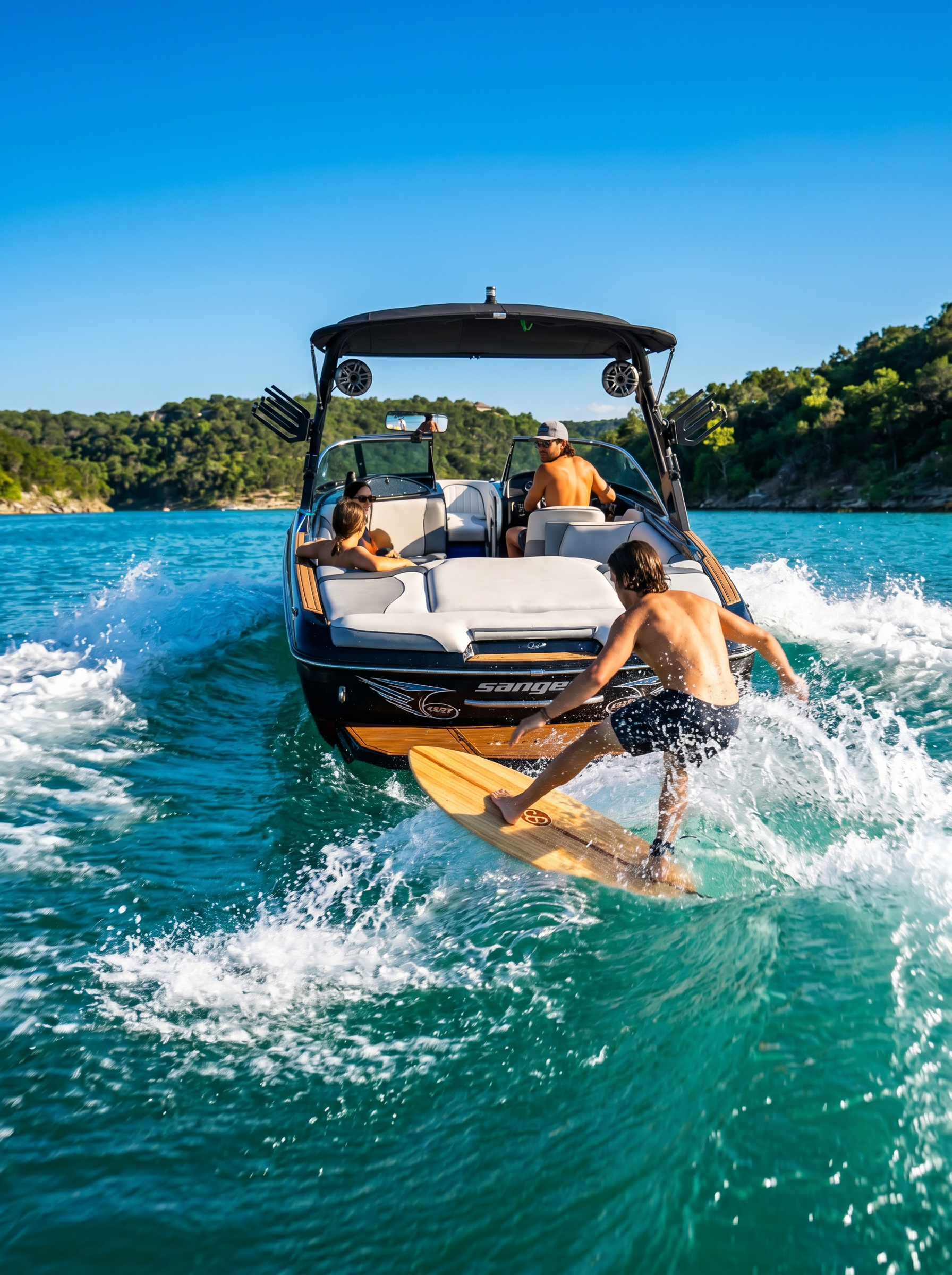
Pumping a wakesurf board can look like a rider simply bouncing their knees. Copy that appearance, though, and you may end up with tired legs, a buried nose, or a board that falls farther behind the boat.
Good pumping is not repeated jumping. It is a coordinated use of the wave's slope, board direction, and controlled leg movement to maintain or regain useful speed. The aim is to keep the board moving through a productive part of the wave, not to create the biggest possible body movement.
This guide explains how to pump a wakesurf board with small, connected movements, recognize common mistakes, and practice safely during a Lake Austin lesson. It is intended for riders who can already get up, ride with control, and follow their instructor's directions. If those skills are still developing, pumping can wait.
What pumping does, and what it cannot fix
A wakesurf wave has areas where the board accelerates more readily and areas where maintaining speed becomes harder. Riders often call the useful riding zone the pocket, although its exact shape and location depend on the boat, setup, rider, and conditions.
Pumping helps you move through that energy more deliberately. A shallow climb and descent across the wave face, paired with well-timed changes in leg pressure, can help the board maintain momentum.
It is different from simply leaning forward. Moving pressure toward the front foot may help a rider accelerate, but continuing to lean farther forward can eventually bury the nose or put the rider off balance. Pumping adds a repeatable movement pattern rather than asking one static position to solve every speed problem.
It also differs from a large carving turn. Carving emphasizes a deliberate change in direction and a controlled arc. A basic pump usually uses a smaller path, with the emphasis on maintaining useful speed rather than making a dramatic turn.
Pumping is a tool, not an obligation
You do not need to pump constantly to be wakesurfing correctly. If you are comfortably maintaining position, quiet riding is a success.
Continuous pumping can hide a problem with board selection, riding position, or technique. It can also leave a rider exhausted without improving control.
Use pumping when there is a clear reason, such as correcting a small backward drift or practicing speed management. Then return to a stable ride.
Some losses of speed are not recoverable
Once the board has moved beyond the useful part of the wave, increasingly forceful movement may not bring it back. There is no benefit in chasing a failed recovery until you fall awkwardly.
A useful distinction is between a small loss of position and a ride that is already ending. Your instructor can help you recognize that difference. Learning when to stop trying is part of good technique, not a sign of failure.
Check the foundations before trying to pump
Pumping adds movement to a balance task. If the underlying balance is uncertain, adding more motion usually makes the uncertainty larger.
Before practicing, you should be able to:
- Maintain a comfortable riding position without constantly pulling against the rope.
- Keep your knees flexible without collapsing into a deep squat.
- Make modest speed adjustments without lunging toward the boat.
- Look ahead rather than staring continuously at your feet.
- Follow the crew's instructions about the rope, stopping, and pickup.
- End an attempt without trying to save the board at all costs.
These are readiness checks, not a promise that you must achieve a particular milestone on a particular outing. Some riders are ready to explore pumping early. Others benefit more from additional steady riding.
Let the instructor check the board and wave
A board that is a poor match for the rider can make speed management unnecessarily difficult. So can a riding position that leaves little usable wave face beneath the board.
Ask the instructor to watch a normal ride before diagnosing the problem yourself. They can assess whether you are losing speed because of timing, excessive drag, an unsuitable board, or where you are riding.
Do not ask passengers to move around unpredictably or attempt to change the boat's setup yourself. The captain is responsible for operating the vessel and managing its configuration within safe limits. You can review the vessel information before your outing, but an on-water assessment still matters.
Understand the movement before making it bigger
The most useful beginner description is a small, smooth path up and down the wave face with coordinated flexion and extension through the legs.
That description has two important parts: the board travels through the wave, and the rider manages pressure as it does so. Knee movement without a useful board path often produces little more than bouncing.
Start with a shallow path across the face
Picture a gentle rolling path rather than a steep zigzag. The board rises modestly on the face, then redirects down and forward into useful slope.
You do not need to drive all the way to the crest. Climbing too high can leave the board without the support and slope you need for the next part of the movement. Likewise, dropping too far into the flat water outside the face can remove you from the wave's useful energy.
The appropriate path depends on the wave and board. That is why the instructor's observation is more valuable than trying to imitate the exact height or rhythm of another rider.
Let your legs manage pressure
Keep your ankles, knees, and hips responsive. Your legs should allow the board to move beneath you while your upper body stays comparatively calm.
As the board transitions through its path, flexing and extending your legs changes the pressure applied to it. The timing matters more than the depth of the squat. A small movement matched to the board's direction can be more effective than a large movement at the wrong moment.
Avoid locking your knees at the top of an extension. Also avoid dropping into a squat so deep that you cannot smoothly redirect or absorb the next movement.
Because board shape and wave geometry vary, do not force a rigid universal count for when to bend and straighten. Have the instructor cue the movement while watching your board's actual response.
Keep your torso from doing all the work
Throwing your shoulders forward and backward may feel energetic, but it can make the board less predictable. Large arm swings can create a similar problem.
Keep your gaze along your intended path and allow modest, natural arm movement for balance. Think of your torso as staying composed while your legs make the useful adjustments.
If your head is bobbing dramatically but the board is not tracing a controlled path, reduce the movement. More effort is not automatically more propulsion.
A practical progression for your first pumping attempts
Practice works best when each attempt answers a simple question. Did the board follow a useful path? Did your movement improve position? Could you stop pumping and ride calmly again?
Avoid combining a new pumping rhythm, a new board, and an attempt at a larger turn in the same exercise. Make one change at a time.
Establish a quiet baseline
Begin by riding as steadily as you can in a position approved by the instructor. Notice your distance from the boat, the feel of the board under your feet, and how much leg effort you are using.
This baseline gives you something to compare against. Without it, any busy movement can feel like progress even if it is making you slower.
If you cannot settle into a controlled ride, return to foundational work rather than forcing the next step.
Try one small cycle
From a stable position, follow the instructor's cue for a shallow rise and return on the face. Keep the movement small enough that you can interrupt it without a major balance correction.
The goal is not an impressive burst of speed. It is to feel the connection between the board's path and your leg pressure.
After that cycle, return to quiet riding. Ask yourself whether the board moved more freely, whether you stayed balanced, and whether you finished in a useful position.
Connect a short sequence
Once an individual cycle feels controlled, connect a brief sequence without pausing between each movement. Aim for a smooth rhythm rather than a rapid series of jolts.
Stop the sequence while you still have control. Continuing until you are exhausted makes it harder to identify which part of the movement was working.
Your instructor may ask you to reduce the range, change the path, or soften a pressure change. Treat those as separate experiments rather than trying to fix everything at once.
Practice a small recovery
Only after the rhythm becomes reliable should you use it to correct a modest backward drift. Start the correction early, while there is still useful wave beneath the board.
Do not deliberately ride far out of position to create a challenge. An exaggerated recovery attempt adds risk and often teaches frantic movement instead of good timing.
Success is returning to a comfortable riding position and settling down again. If you gain speed but cannot manage the resulting forward movement, the exercise is not yet complete.
Common pumping mistakes and what to change
Most early problems come from too much movement, poorly directed movement, or practicing from a position where the wave cannot help you.
Use the following signs to describe what happened to your instructor. They are starting points for a diagnosis, not proof of a single cause.
You bounce vertically but keep falling behind
This often means your body is moving more than the board is traveling across the face. You may also be applying pressure at a moment that slows the board rather than helping it move through the slope.
Reduce the bounce and focus on a shallow, deliberate board path. Ask the instructor to watch where the nose travels, not just how much your knees bend.
A useful cue is: make the path clearer before making the movement stronger.
The nose repeatedly dips into the water
A buried nose can follow an abrupt forward lunge, too much forward pressure, or a poorly directed descent. Board fit and foot position may also contribute.
Do not respond by throwing your whole body backward. That may stall the board and set up another exaggerated correction.
Return to a neutral ride if you can, reduce the movement, and let the instructor check your position. The goal is a smaller, more balanced pressure change, not a battle between extreme forward and backward leans.
You climb high and lose momentum
A higher path is not always a better path. If you push onto the crest or beyond the useful face, you may lose the slope needed to redirect smoothly.
Practice lower, shallower movements under the instructor's guidance. You want enough vertical travel to use the wave, not so much that every cycle becomes a rescue.
You drop into the flat and cannot return
This can happen when a down-the-face movement continues too far away from the wave. The board may initially accelerate, then lose support as it leaves the useful riding area.
Make the path smaller and redirect earlier. Avoid looking toward open water if that draws your shoulders and board away from the face.
You accelerate toward the boat
Pumping can produce more forward movement than you expected. That is a reason to stop the pumping sequence early, not to continue until you are uncomfortably close.
Use the speed-control technique your instructor has taught you and maintain the instructed separation from the boat. Never reach for the swim platform or attempt to use the boat as a handhold.
If you cannot manage forward speed consistently, return to basic speed control before practicing another sequence.
Your legs burn before the movement improves
Deep squats, stiff ankles, and nonstop pumping can all create unnecessary fatigue. A long, effortful attempt is not necessarily a productive one.
Shorten the practice block and return to steady riding between attempts. If your legs are shaking or your reactions are getting slower, stop and recover on board according to the crew's directions.
Rope handling and pumping practice
A rope can provide support during foundational instruction, but pulling yourself forward is not the same as generating speed through pumping. If the line is doing the work, it becomes harder to tell whether the technique is effective.
Your instructor should decide whether a particular drill is appropriate with the rope or after you can ride without it. Never release the rope simply because a pumping exercise sounds more advanced without one.
If the rope is in use:
- Keep it away from your feet and board.
- Never wrap it around a hand, arm, or any other body part.
- Do not gather loose coils while riding.
- Follow the crew's established release and retrieval procedure.
- Stop the drill if the line position becomes unsafe.
Do not try to catch a discarded handle while surfing or move toward the boat to retrieve one. Let the crew manage the rope and decide when to reset.
Keep speed practice inside clear safety limits
Pumping changes your speed and path. That makes awareness especially important, even when the movement feels small.
Wear a properly fitted, activity-appropriate, Coast Guard-approved life jacket. Use a boat designed and configured for wakesurfing, with the captain managing operation and rider recovery. Technique advice is not a substitute for a safe boat setup or in-person instruction.
Keep clear of the platform and exhaust area. Never hold onto the platform while the boat is running or moving, and follow crew instructions for entering and leaving the water.
Make the goal clear before the boat moves
Tell the instructor what you want to work on before the attempt. Agree on the cue for ending the drill and what you will do if the recovery stops working.
A single clear objective is easier to coach than a rider trying several new movements without warning. It also helps the crew distinguish planned board movement from a loss of control.
Do not fight an uncontrolled fall
If the board escapes your control, do not grab for it or make a desperate twisting movement to stay upright. Follow your instructor's falling guidance, protect your head, and avoid diving into the water.
Once you are down, use the agreed signal and wait for pickup instructions. Do not swim toward a moving boat to shorten the reset.
Stop when fatigue changes your decisions
Fatigue is not only a feeling in your legs. It can appear as delayed reactions, repeated missed cues, or increasingly forceful attempts to recover a bad position.
Take a break before those patterns become your normal riding style. Keep alcohol out of your riding practice, drink water, and allow enough recovery between turns to pay attention again.
Practicing on Lake Austin without forcing the conditions
A useful drill needs a predictable enough wave for you to understand cause and effect. On Lake Austin, other boat traffic and changing surface conditions can interrupt that feedback.
If another wake crosses your path, prioritize balance and the captain's instructions rather than finishing a pumping sequence. The right response may be to ride quietly, stop the attempt, or wait for a better practice opportunity.
The captain decides where and when operating conditions are suitable. Do not pressure the crew to maintain a practice line when traffic, shoreline considerations, or other conditions call for a change.
For broader trip preparation, the Lake Austin guide can help you put the lesson within the rest of your lake day. Confirm your departure details directly rather than assuming a particular access point.
Tell the crew your actual starting level
When booking, describe what you can do now rather than labeling yourself only as beginner or intermediate. Useful details include whether you can ride without the rope, maintain position, and slow down deliberately.
You can also explain the specific problem: 'I stay up, but every pumping attempt makes me fall behind' gives the instructor more to work with than 'I want to get better.'
There is no need to promise an ambitious goal. A session that replaces frantic bouncing with one controlled movement can be valuable progress.
Planning a technique-focused charter
Texas Wakesurf Charters offers captained private wakesurf and lake-day charters on Lake Austin in Austin, Texas. Included are an expert captain and water sports instructor, fuel, top-tier water sports equipment, and a complimentary cooler with ice.
For a pumping-focused outing, tell the team that you want coached speed-management practice. A private charter lets your group discuss its preferred balance of riding and lake time with the crew, subject to conditions and safe operation. It does not guarantee a particular skill breakthrough.
Review pricing when planning your budget. A mandatory 20% gratuity is due to the captain. Public wake surf sessions are $100 per person with 5–8 people and are not private, so choose the format that matches your expectations rather than assuming every booking reserves the boat for your group.
You can explore the available experiences and review policies before reserving. Ask about any booking-specific questions directly, including how your group's riding goals fit the outing you are considering.
Measure progress by control, not how busy you look
A better pump usually looks calmer as it becomes more effective. The board follows a purposeful path, your legs respond smoothly, and you can stop the movement without losing your position.
Look for these signs of progress:
- You recognize a small backward drift before it becomes a lost wave.
- You use less upper-body effort to make a useful correction.
- You can connect movements without exaggerated bouncing.
- You return to quiet riding after gaining speed.
- You stop an unsuccessful recovery instead of forcing it.
Those are more useful goals than trying to pump continuously or copy someone else's rhythm. Build the movement around your board, the available wave, and the feedback of the instructor watching you.
Ready to replace bouncing with more controlled speed management? Book a charter and tell the team you would like to work on wakesurf pumping technique.
Frequently asked questions
What does pumping mean in wakesurfing?+
Pumping combines a controlled path up and down the wave face with coordinated leg movement and pressure changes. It helps a rider maintain or regain useful speed without relying only on a static forward lean.
Why do I lose speed when I pump my wakesurf board?+
Common causes include bouncing vertically without a useful board path, poorly timed pressure changes, climbing too high, or dropping too far into flat water. An instructor can also check whether your board and riding position are contributing.
Do I need to pump constantly to stay on the wave?+
No. If you are maintaining a comfortable position, steady riding is appropriate. Constant pumping can hide a technique or equipment issue and create unnecessary fatigue.
Should I learn pumping before riding without the rope?+
Develop steady riding and basic speed control first. Your instructor can decide whether a preparatory drill with the rope is useful. Pulling on the line can mask whether pumping is actually producing speed, and safe rope handling remains essential.
Can pumping recover a ride after I fall far behind the boat?+
Not always. Pumping is most useful for a small loss of position while the board still has useful wave beneath it. Once you are beyond that area, forcing larger movements may only create an uncontrolled fall.
Can I request pumping instruction on a Lake Austin charter?+
Yes. Tell Texas Wakesurf Charters your current abilities and that you want to work on pumping and speed management. Private charters include an expert captain and water sports instructor, with practice adapted to your readiness and operating conditions.
Ready to ride?