
How Do Wakesurf Board Fins Affect Stability, Turning, and Grip?
October 18, 2026 · By Jordan Miller
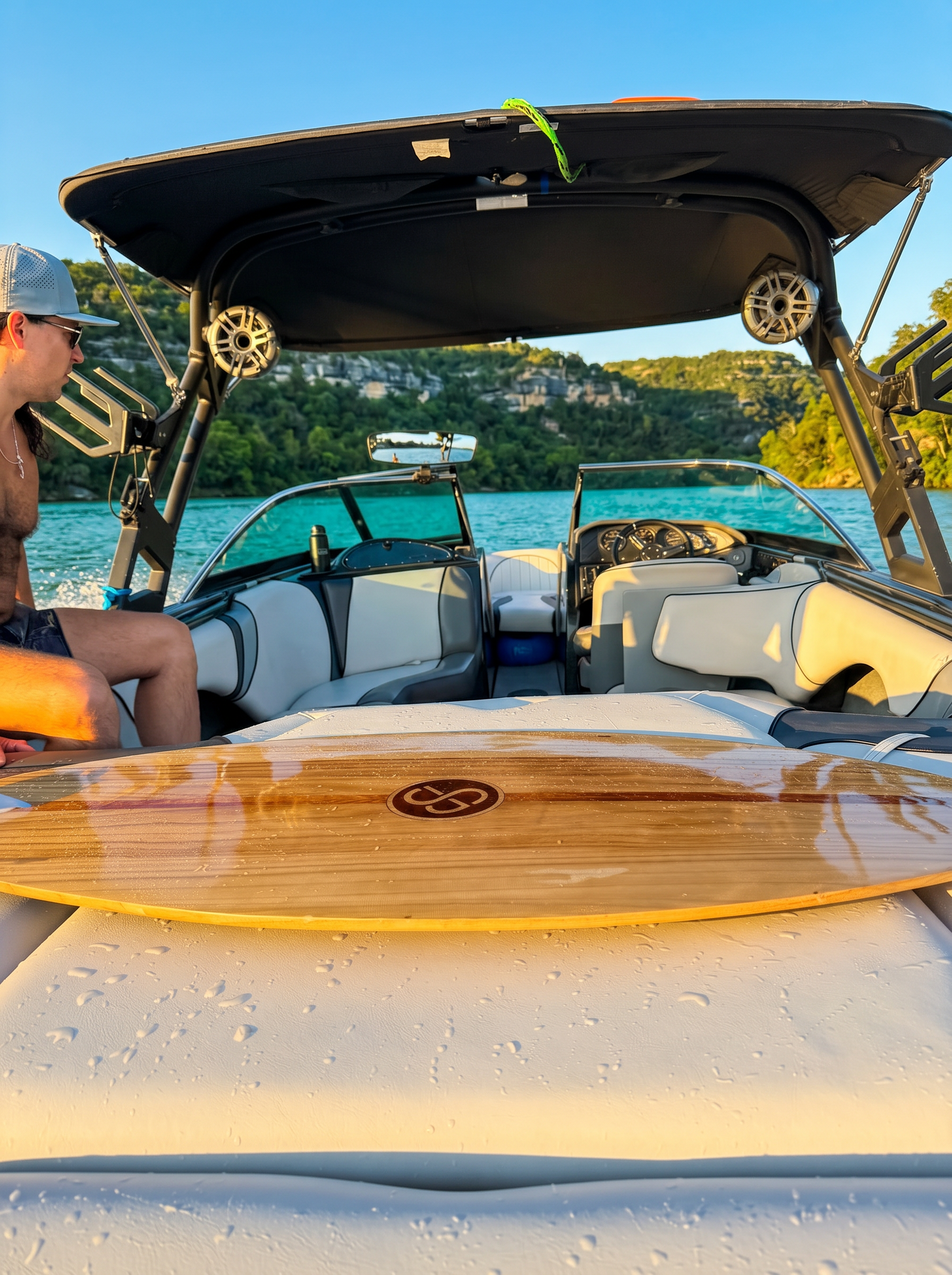
Wakesurf board fins influence how firmly a board tracks, how readily its tail releases, and how it responds when you turn across the wave.
The right fin setup depends on the board's design, your riding goals, and how much grip you need. Start with the manufacturer's recommended configuration, then change one variable at a time.
For beginners, the practical goal is a predictable board, not the most fins or the loosest ride. For progressing riders, understanding fins can help separate an equipment issue from a stance, technique, or wave-position issue.
What do wakesurf fins actually do?
A fin is a shaped surface mounted beneath the board, usually near the tail. As water flows around it, the fin helps resist sideways movement. Combined with the board's rails and bottom shape, that resistance helps the rider hold a direction and control turns.
Fins do not make a board stable in every sense. They primarily influence directional control and grip. Board width, volume, outline, and the rider's stance also affect how balanced the board feels.
These terms describe different parts of the experience:
| Term | What it means on the water | What the rider may notice |
|---|---|---|
| Tracking | The tendency to maintain a direction | The tail wanders less during a straight glide |
| Hold or grip | Resistance to sliding sideways under load | The board feels more secure when its rail is engaged |
| Release | How readily the tail breaks free | The board pivots or slides more easily |
| Drive | The forward response created through loaded turns and pumping | Pressure through a turn helps carry the board along the wave |
| Drag | Resistance as the board moves through water | An unsuitable setup may feel less free-flowing |
These characteristics overlap. A fin that provides useful hold in a turn can also make a rotation harder. More grip is not automatically better, and less drag does not automatically make a setup easier to ride.
How fin size and shape change the ride
Fin count is only one part of the setup. Two boards with the same number of fins can feel substantially different because of fin dimensions, placement, and board shape.
Area and depth
Fin area is the total surface area of the fin. Depth describes how far it extends below the board.
All else being equal, greater area often provides more resistance to sideways movement. A deeper fin can also offer stronger hold. Smaller or shallower fins generally release more readily, but may feel less forgiving when the rider applies abrupt pressure.
These are tendencies, not guarantees. A large fin cannot compensate for poor foot placement or a board that is unsuitable for the rider.
Base length and rake
The base is the part of the fin running along the board. Rake describes how far the fin sweeps backward toward its tip.
A longer base commonly contributes to a more driven feeling through turns. A more upright fin often feels more willing to pivot, while a swept-back shape often favors longer, flowing turns. The full fin outline matters more than any single measurement.
Foil and flex
The foil is the fin's cross-sectional shape. Some fins are symmetrical; others are shaped differently on their two faces and are intended for a particular side of the board.
Flex describes how much the fin bends under load. A stiffer fin may feel more immediate, while a more flexible fin may respond differently as pressure builds and releases. Neither is universally better.
Do not swap side-specific fins left to right unless the manufacturer permits it. A fin that physically fits a box is not necessarily positioned or oriented correctly.
Common wakesurf fin configurations
A fin box is the mounting socket that holds a removable fin. Some boards have multiple boxes to support alternative configurations, but those options must be confirmed by the manufacturer.
| Configuration | Typical arrangement | General riding tendency | Important limitation |
|---|---|---|---|
| Single fin | One center fin near the tail | A small skim-style fin can allow easy release and rotation | A larger single fin behaves differently; count alone is misleading |
| Twin fin | Two side fins | Often feels lively and relatively free through turns | Hold depends heavily on fin size, placement, and rail design |
| Thruster | Two side fins and a center fin | Commonly balances turning control with directional hold | A large center fin may make tail release harder |
| Quad | Two forward side fins and two rear side fins | Often supplies substantial hold and drive through engaged turns | Rear-fin dimensions and placement strongly affect the feel |
A board with five fin boxes may be designed to accept either a thruster or quad setup. Five boxes do not automatically mean all five fins should be installed together.
Likewise, removing a center fin from a thruster does not guarantee the board will behave like a purpose-designed twin. The remaining fin positions and board shape still matter.
Do surf-style and skim-style boards need different fins?
Generally, yes, because they are designed around different riding characteristics.
Surf-style wakesurf boards commonly use larger fins and multi-fin arrangements to support carving and loaded turns. Skim-style boards commonly use a smaller center fin, allowing a flatter, more rotation-friendly ride. Hybrid designs combine elements of both.
These categories are useful starting points, not installation instructions. Check the specific board's recommended setup rather than selecting fins solely because a package says “surf” or “skim.”
For a beginner, a very small skim fin may feel less directionally secure. However, adding the largest available fin is not necessarily the solution. A different board or a stance adjustment may be more useful.
Step by step: choose and test a fin setup
Step 1: Identify the board and mounting system
Find the board's model information and manufacturer guidance. Confirm the fin-box system, compatible fin type, intended configurations, and any left, right, front, or rear designations.
Do not force a fin into a box or assume similar-looking mounting tabs are interchangeable. If the board is rented or provided during a lesson, ask the instructor before changing anything.
Step 2: Inspect the board and fins
With the board supported securely out of the water, check for:
- Cracks around the fin boxes.
- Loose, missing, or damaged mounting hardware.
- Split, chipped, or sharply damaged fins.
- Sand or debris inside the mounting interface.
- Movement that remains after correct installation.
Do not ride a board with a loose fin or visibly damaged box. Have the issue assessed before returning it to service.
Step 3: Install the recommended baseline
Start with the manufacturer's standard configuration. Use the specified tool and fastening method. Tighten only as directed; excessive force can damage screws, mounting tabs, or boxes.
Some systems use screws, while others use a different retention mechanism. Do not assume a fin key is required for every board.
Check that each fin seats correctly and is retained according to the manufacturer's instructions.
Step 4: Establish a controlled comparison
Before changing fins, ride long enough to identify a specific issue. “The tail slides during a toe-side turn” is more useful than “the board feels wrong.”
Keep the comparison as consistent as practical:
- Use the same board and rider.
- Avoid deliberately changing boat speed, ballast, and fins together.
- Ride on the same side of the wave.
- Compare similar maneuvers rather than unrelated tricks.
- Note changes in wind, boat traffic, or surface chop.
On Lake Austin, passing wakes and changing surface texture can make consecutive rides feel different. The Lake Austin guide provides broader planning context, but the captain's assessment of current conditions should guide the session.
Step 5: Change one approved variable
If an adjustment is appropriate, change one thing: a compatible fin size, an approved configuration, or another manufacturer-supported option.
Make changes with the board out of the water in a secure location, not while it floats beside the boat. Keep tools and loose hardware contained.
Ride again and compare the same behavior. If the result is unclear, return to the baseline rather than stacking several changes together.
Troubleshooting: fins or technique?
Equipment changes are most useful when the problem is repeatable. Many apparent fin problems start with stance or wave position.
| What you feel | Possible fin contribution | Check before changing equipment |
|---|---|---|
| Tail slips during turns | Insufficient hold for the pressure being applied | Abrupt foot pressure, rail engagement, and foot placement |
| Board feels reluctant to pivot | More fin hold than the maneuver needs | Whether your weight is positioned appropriately for the turn |
| Board wanders during a straight glide | A small fin or loose-feeling configuration | Overcorrection, uneven stance, and choppy water |
| Board drops out of the wave | An unsuitable setup may contribute resistance | Pocket position, excessive rear-foot pressure, and board suitability |
| Board repeatedly catches a rail | Fin response may influence the turn | Rail angle, body position, and sudden direction changes |
Do not use fin adjustments as a substitute for coaching. A short observation from an instructor can reveal whether the board needs changing or the rider needs a different movement cue.
For related equipment and technique topics, browse the knowledge base.
Fin handling and safety
Fins can cut skin and damage upholstery. Carry the board with awareness of where the fins point, and keep them away from other passengers during handoffs.
Do not stand a board on its fins or rest your body weight on them. Use a storage position that supports the board without loading the fins or their boxes.
During a fall, avoid trying to catch the board. Follow the captain's recovery instructions and remain aware that the board may rotate, exposing its fins.
Never experiment with an unapproved fin installation to solve a riding problem. A loose or incompatible fin is a hardware concern, not a tuning option. Fin selection also does not change the need for an appropriate life jacket, safe boat operation, and attentive rider supervision.
Using provided equipment on a Lake Austin charter
On a charter, describe your experience level and riding goal before asking for a particular configuration. The instructor can match available equipment to your needs and determine whether an adjustment is warranted.
Texas Wakesurf Charters provides captained private wakesurf and lake-day charters on Lake Austin in Austin, TX. Included are an expert captain and water sports instructor, fuel, top-tier water sports equipment, and a complimentary cooler with ice. A mandatory 20% gratuity is due to the captain.
Review pricing and experiences for booking information. Ask about equipment suitability in advance rather than assuming a specific board model or fin set will be available.
Ready to work on board control with an instructor? Book a charter on Lake Austin.
Frequently asked questions
Are more fins better for beginner wakesurfers?+
Not automatically. Beginners generally benefit from predictable tracking and grip, but fin size, placement, board shape, and stance all matter. Start with the board manufacturer's recommended setup and ask an instructor to assess how it rides.
Can I remove the center fin from my wakesurf board?+
Only if the manufacturer supports that configuration. Removing the center fin may make the tail easier to release, but it does not necessarily turn the board into a well-matched twin-fin design.
Should I install fins in all five boxes on my board?+
Not unless the manufacturer specifically recommends it. Five boxes may provide a choice between thruster and quad configurations rather than a setup intended to use all five fins together.
Why does my wakesurf board's tail slide during turns?+
The fin setup may provide less hold than the turn demands, but abrupt pressure, foot placement, and rail engagement can also cause sliding. Have an instructor check technique before changing compatible fins one variable at a time.
Are wakesurf fins interchangeable between boards?+
Not universally. The mounting system, fin dimensions, orientation, and intended configuration must be compatible. Confirm the board manufacturer's guidance and never force a fin into a box.
Ready to ride?