
How Does Wind Affect Wakesurfing on Lake Austin?
October 22, 2026 · By Jordan Miller
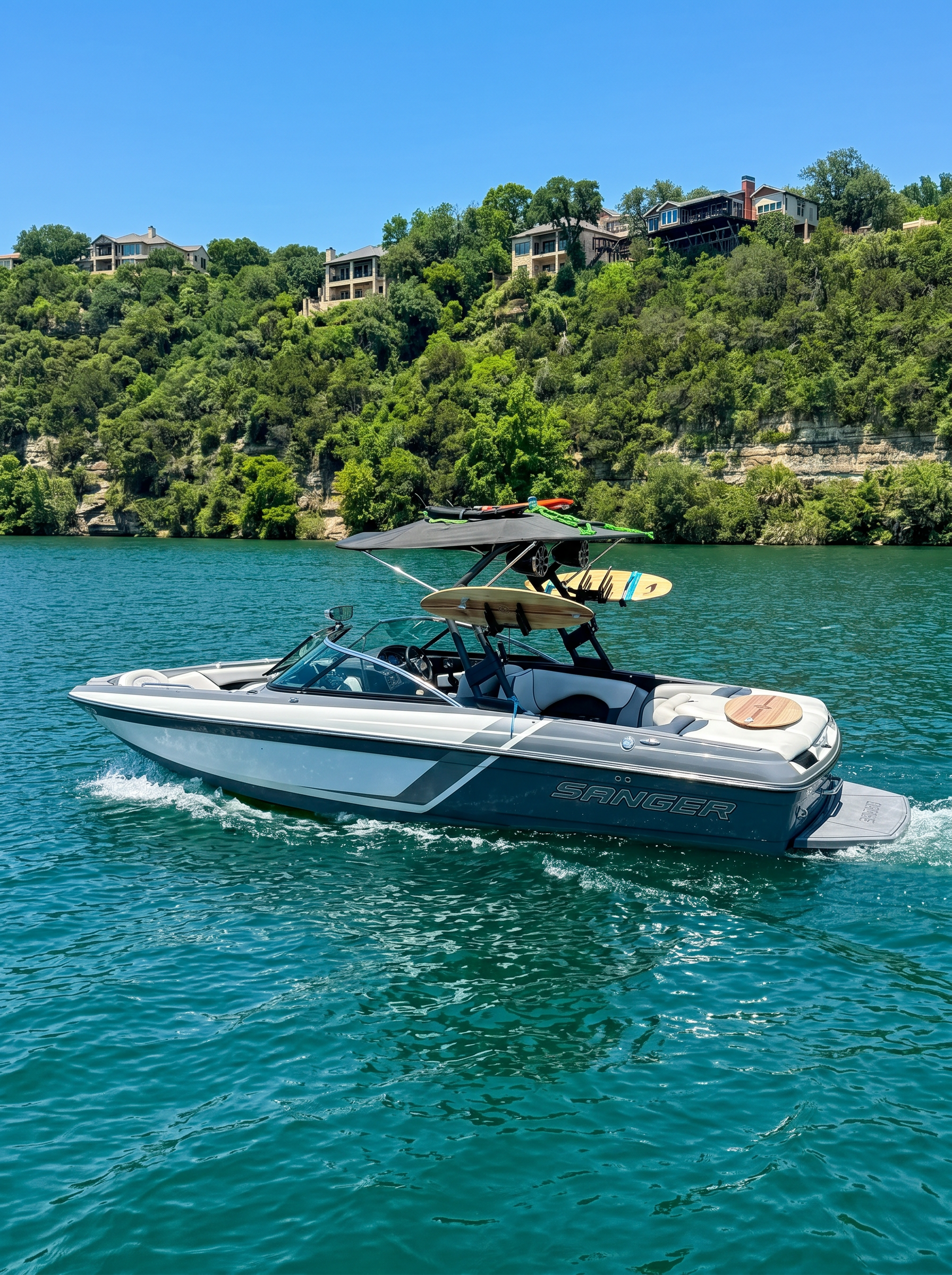
What wind changes for a wakesurfer
Wind speed alone cannot tell you whether Lake Austin will be suitable for wakesurfing. Direction, fetch, boat traffic, and rider ability also matter.
Wind creates surface waves that can overlap with the boat's surf wave. Those moving bumps make board pressure less predictable, interrupt balance, and complicate starts and rider pickups. Gusts can also affect how a boat drifts when it is moving slowly or waiting for a rider.
For wakesurfing, the useful question is not simply whether it is windy. It is whether the available water gives the rider and captain enough visibility, control, and safe operating space.
There is no universal wind-speed cutoff that makes every wakesurf outing safe or unsafe. The captain must assess the actual conditions, the boat's operating limits, local restrictions, and the people aboard. A weather app is an input to that decision, not permission to ride.
Wind, chop, fetch, and boat wakes: clear definitions
These terms describe different influences on the water. Separating them helps explain why two stretches of the same lake can feel very different.
| Term | Meaning | Why it matters for wakesurfing |
|---|---|---|
| Sustained wind | Wind averaged over a reporting period | Provides background context, but does not describe every gust or local exposure |
| Gust | A brief increase in wind speed | Can change surface conditions and boat drift quickly |
| Fetch | The uninterrupted distance wind travels over water | Longer fetch generally allows wind waves to develop more, depending on wind strength and duration |
| Wind chop | Short, closely spaced surface waves generated by wind | Adds repeated bumps beneath the board and across the surf wave |
| Boat wake | Waves produced by another vessel | Can cross the surf wave even when the air is calm |
| Reflected waves | Waves that bounce off hard shorelines or structures | Can create intersecting bumps and less predictable water |
| Whitecaps | Breaking crests on wind-generated waves | Signal rougher surface conditions, but their absence does not establish safety |
The surf wave is the wave deliberately generated by the towing boat. Chop and passing wakes are outside disturbances. Changing the boat's surf settings cannot remove those disturbances from the surrounding water.
Why conditions vary across Lake Austin
Lake Austin's bends, shoreline terrain, and changing exposure can produce different surface conditions along a route. Wind blowing along an open stretch has more room to build waves than wind crossing a short span of water.
A section sheltered from one wind direction may be exposed when the wind shifts. Wind direction in a forecast indicates where the wind comes from. A north wind, for example, blows from the north toward the south.
Shoreline shelter is not automatically a suitable riding area. A smooth-looking strip of water may be too close to docks, swimmers, moored boats, shallow water, or other hazards. Posted restrictions and adequate operating room take priority over finding glassy water.
Boat traffic adds another variable. A sheltered stretch can still become difficult to ride when wakes arrive from several directions. Conversely, visible ripples do not necessarily mean a session must stop if the captain determines that the water, visibility, and operating space remain suitable.
For broader trip context, see the Lake Austin guide. No general lake guide replaces an on-water assessment that day.
How to assess conditions before a wakesurf session
Step 1: Check more than the headline wind speed
Review the forecast for the actual lake area and the planned time on the water. Look at sustained wind, gusts, direction, thunderstorms, and any relevant weather alerts.
Pay attention to trends. A forecast showing increasing gusts or approaching storms deserves a different plan than one showing steady conditions. A calm launch area does not prove that exposed water farther along the route will remain calm.
Do not treat smooth water as evidence that a thunderstorm is harmless. If thunder is heard or lightning is seen, stop water activities and seek appropriate shelter under the captain's emergency plan. An open boat is not safe lightning shelter.
Step 2: Observe the intended riding area
Before putting a rider in the water, the captain should assess the route and surrounding traffic. Useful observations include:
- Whether surface waves are small and consistent or steep and irregular.
- Whether passing wakes repeatedly cross the intended line.
- Whether glare, spray, or shoreline shadows make a rider difficult to see.
- Whether there is enough room for a controlled stop and pickup.
- Whether the boat is drifting toward hazards while moving slowly.
- Whether a safe return route remains available if conditions worsen.
The captain should not conduct a test run through an occupied swimming area or use proximity to shore as a substitute for safe separation.
Step 3: Match the conditions to the rider
A beginner learning a deep-water start needs a more forgiving environment than an experienced rider who can absorb small bumps and control board speed.
Consider confidence in the water, fatigue, and ability to follow instructions. Someone who is cold, anxious, or struggling to recover after falls may need a break even when other riders are comfortable.
Conditions should be appropriate for the person taking the next turn, not merely manageable for the strongest rider aboard.
Step 4: Agree on communication and stopping criteria
Wind and engine noise can make shouted instructions difficult to understand. Review hand signals before the rider enters the water, and maintain a clear lookout and communication plan consistent with applicable requirements.
Agree that the session will pause if the rider cannot reliably receive instructions, the captain loses a suitable operating area, or repeated falls indicate deteriorating control. A rider should always be able to request a stop without pressure to continue.
Step 5: Reassess throughout the session
Conditions can change between turns. Check again after a wind shift, increased traffic, a cluster of crossing wakes, or a noticeable change in rider confidence.
A successful first run does not guarantee that the next one is appropriate. Relocating, taking a break, or ending water sports may be the correct decision.
What different conditions mean in practice
The following table is a decision aid, not a wind-rating system or a substitute for the captain's judgment.
| Observation | Likely effect on the rider | Practical response |
|---|---|---|
| Light ripples with clear visibility and room to maneuver | Small balance adjustments may be needed | Proceed only after the captain confirms the area and rider are suitable |
| Frequent crossing boat wakes | Sudden changes in board pitch and surf-wave shape | Wait for the water to settle or use another permitted area |
| Short, steep chop | Harder starts and repeated loss of balance | Reduce the difficulty of the session, relocate, or pause |
| Gusts affecting low-speed control | More complicated positioning and pickup | Keep riders aboard until the captain can maintain safe control |
| Glare or spray obscuring a rider | Reduced ability to monitor and recover the rider | Change the operating plan or stop riding |
| Thunder, lightning, or an approaching severe storm | Weather exposure beyond a technique problem | End water activities and follow the emergency shelter plan |
Technique adjustments for mild surface chop
These adjustments apply only when the captain has already determined that riding is appropriate. They do not make unsafe conditions acceptable.
Keep your legs responsive
Use comfortably bent knees and allow your legs to absorb small changes beneath the board. Locked knees transfer each bump into the upper body and can make balance corrections abrupt.
Keep your gaze forward toward your path rather than staring continuously at your feet. Aim for quiet upper-body movements instead of trying to counter every ripple with your shoulders.
Use smaller pressure changes
Chop can momentarily change how much of the board contacts the water. Large, sudden weight shifts can exaggerate that movement.
Make gradual fore-and-aft pressure adjustments. If the board becomes unstable, return to a controlled position rather than trying to force a turn or save every ride.
Treat rope-assisted practice as practice, not a rescue strategy
An instructor may use rope-assisted drills while a rider learns to balance in manageable conditions. Keep the line clear of the body and never wrap it around a hand, arm, or leg.
If the rider falls or loses control, release the handle. Hanging on through a fall is not a safe way to overcome chop. If balance remains unreliable, stop and reassess rather than extending the drill.
Shorten demanding turns
Repeated starts and falls can tire a rider before they recognize the change. Take breaks when coordination declines, instructions become harder to follow, or recovery feels increasingly difficult.
A shorter, controlled turn is more useful than continuing until fatigue makes a routine pickup harder.
Can boat setup fix a wind-affected surf wave?
Boat setup can improve the boat-generated wave within the manufacturer's operating guidance. It cannot flatten wind chop, eliminate traffic wakes, or restore poor visibility.
Do not add ballast simply because rough water makes the surf wave look less clean. Additional loading can reduce freeboard and alter handling. Passenger placement, ballast, speed, and surf-system settings must remain within the vessel's limits and appropriate for the conditions.
Likewise, increasing speed is not a general solution to rough water. The captain must choose settings that preserve control and suit the boat, rider, and operating area.
Equipment changes are secondary. A more forgiving board may help a rider handle mild irregularities, but no board makes an unsuitable area safe. The same is true of life jackets: proper flotation is essential, but it does not remove weather or collision risk.
See vessel information for boat context and the knowledge base for related equipment and setup guidance.
Planning a Lake Austin charter around changing conditions
Avoid treating any time slot as a guarantee of smooth water. Forecasts, local exposure, and traffic all affect what the captain finds on arrival.
Tell the operator whether the group includes first-time riders and whether the priority is instruction or a relaxed lake day. Keeping the plan flexible allows the captain to choose appropriate activities rather than trying to deliver a particular maneuver in unsuitable water.
Texas Wakesurf Charters offers captained private wakesurf and lake-day charters on Lake Austin in Austin, Texas. Included are an expert captain and water sports instructor, fuel, top-tier water sports equipment, and a complimentary cooler with ice. A mandatory 20% gratuity is due to the captain.
Review pricing for current booking details and policies for applicable terms. Do not assume that wind automatically qualifies a booking for cancellation, rescheduling, or a refund.
Ready to plan a session around your group's experience level? Book a charter and share your riding goals before departure.
Frequently asked questions
What wind speed is too high for wakesurfing on Lake Austin?+
There is no universal cutoff. Gusts, direction, fetch, traffic, visibility, boat limits, and rider ability all affect the decision. The captain must assess the actual operating area rather than rely on a single forecast number.
Can Lake Austin be choppy when the wind is calm?+
Yes. Passing boats create wakes that can overlap or reflect from hard shorelines and structures. Calm air does not guarantee smooth water.
Does adding ballast help when the water is choppy?+
Ballast changes the boat-generated wave, not the surrounding wind chop. Adding weight can reduce freeboard and alter handling, so it should not be used as a general fix for rough water.
Can beginners wakesurf in light wind?+
Possibly, if the captain determines that the actual water conditions, visibility, and operating space are suitable. Beginners generally benefit from more forgiving water, and repeated difficulty is a reason to pause or relocate.
Is water near the shoreline always better for wakesurfing?+
No. A shoreline may provide some wind shelter, but docks, swimmers, shallow water, restrictions, and limited maneuvering room can make it unsuitable. Smooth water does not override safe separation or local rules.
Ready to ride?