
Wakesurf Hand Signals: How Riders, Captains, and Spotters Communicate Safely
October 21, 2026 · By Jordan Miller
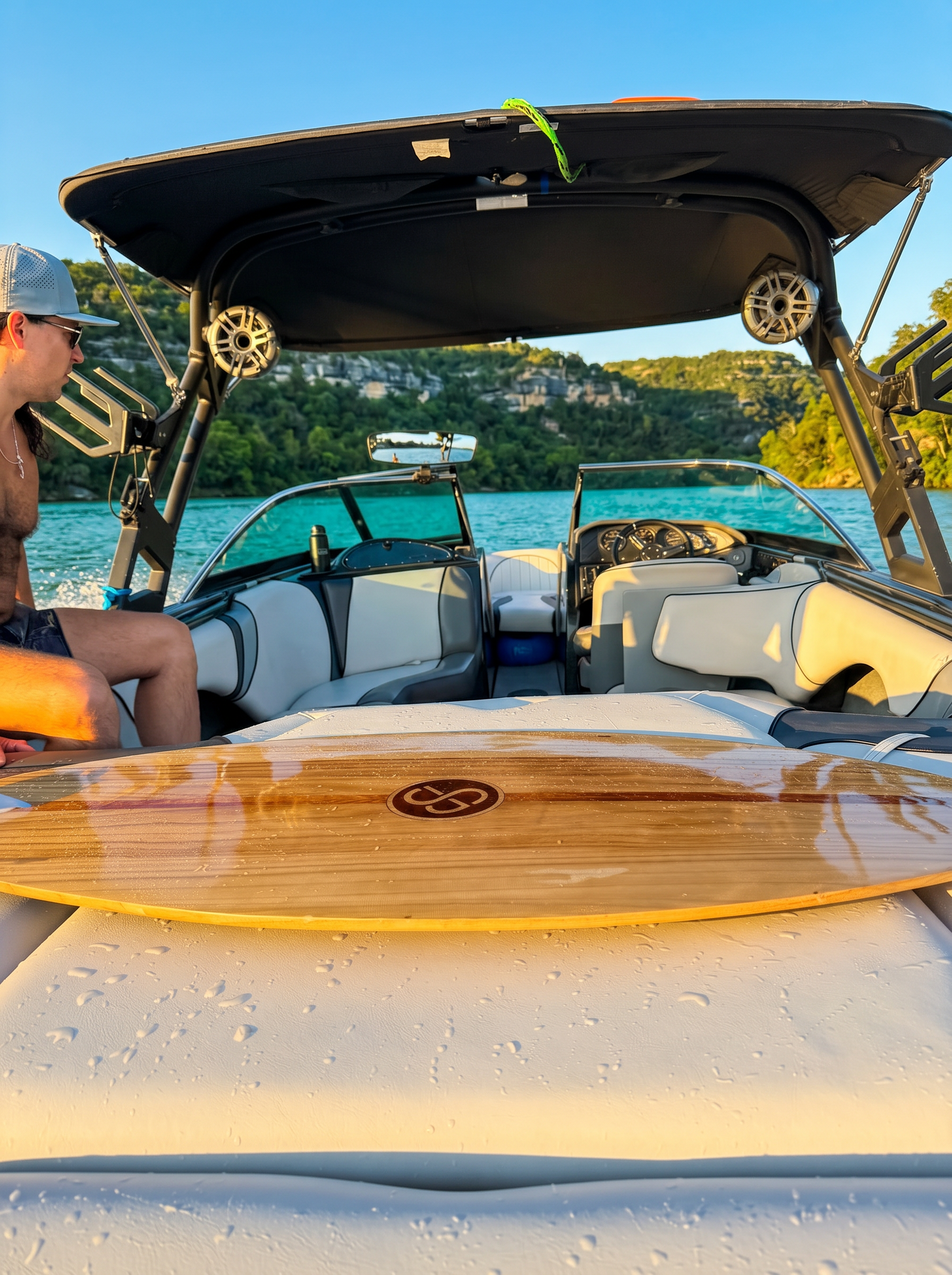
Wind, engine noise, music, and distance can make a simple sentence surprisingly hard to understand behind a wakesurf boat. A rider might shout “stop,” while someone aboard thinks they heard “go.” A friend might offer a useful tip at exactly the moment the instructor gives a different cue.
Wakesurf hand signals solve part of that problem, but memorizing gestures is not enough. Everyone also needs to know who is watching, who is coaching, what each signal means, and what happens when a message is unclear.
A clear communication plan helps a rider ask for help, a spotter relay information, and a captain make decisions without a chorus of conflicting instructions.
This guide explains how to build that plan before a Lake Austin wakesurf ride. It is useful for first-time riders, experienced surfers joining a different boat, and the friends who want to help from their seats.
Why wakesurf communication needs its own briefing
Wakesurfing happens close enough to the boat that conversation can seem possible. Sometimes it is. But being able to hear a few words does not mean a rider can reliably understand a full instruction.
A rider is also processing several tasks at once: balancing, holding the rope, watching the wave, and reacting to movement. Adding multiple voices can make a manageable moment feel rushed.
The boat has its own competing demands. The captain must monitor navigation, surrounding traffic, operating conditions, and the rider's activity. Guests should not assume the captain can watch every gesture continuously while also operating the boat safely.
A useful briefing answers these questions:
- What does the rider do to say they are ready?
- How do they request a normal stop or end their turn?
- What signal means they need help immediately?
- Who watches the rider and relays information?
- Who gives technique instructions?
- What happens if a signal is missed or misunderstood?
Those answers should come before the rider enters the water, not during the first attempt.
Agree on signals instead of assuming everyone knows them
Some watersports gestures are widely recognized, including a thumb up for a request to increase speed and a thumb down for a request to decrease it. However, recognition is not universal, and casual gestures can be mistaken for operating requests.
A thumbs-up can mean “I'm okay” to one person and “go faster” to another. That ambiguity matters on a wakesurf boat.
The safest approach is to have the captain or instructor demonstrate the signals used for that outing. Riders and the designated observer should repeat them back and explain what they mean.
Use a small signal vocabulary
A beginner does not need a complicated language of gestures. Start with the messages that affect the next action:
- Ready for an attempt.
- Not ready or wait.
- Stop or end the turn.
- Need assistance.
- Acknowledge an instruction, if the crew uses a separate acknowledgment.
Speed requests and other adjustments can be added if the instructor wants the rider to use them. The captain retains control over whether any adjustment is appropriate.
Avoid creating several signals that look nearly identical from a distance. A subtle change in finger position may be difficult to see against glare or moving water.
Separate status from operating requests
Before departure or before the first ride, ask: “What should I do to show I'm okay, and how is that different from asking for a change?”
The same principle applies to celebrating. An excited hand wave should not look like the agreed distress signal. Guests can cheer without inventing gestures toward the helm or rider.
If someone joins the session late or switches into the observer role, repeat the briefing. Familiarity with watersports does not guarantee familiarity with that boat's communication plan.
Give the captain, observer, and instructor distinct roles
Clear roles reduce the chance that everyone assumes someone else has seen a problem.
The captain operates the vessel and decides when starting, continuing, adjusting, or stopping is safe. The instructor provides technique guidance. A designated observer, sometimes called a spotter, watches the rider and communicates relevant information promptly to the captain.
On a captained charter, ask the captain how those responsibilities will be assigned. Do not assume a guest should take on a formal role without instruction. Likewise, do not assume that having an instructor means no one else needs to understand the signals.
What a designated observer should focus on
If the captain assigns you to observe, your job is not to film the best clip. It is to keep attention on the rider and relay what you see using the agreed wording.
Useful observations include:
- The rider has signaled to stop.
- The rider has fallen.
- The rider appears to be struggling or needs assistance.
- The rider's signal was unclear.
- The rider is no longer visible from your position.
Report facts rather than guessing motives. “Rider is signaling stop” is clearer than “I think they might be getting tired.”
Stay in the safe position assigned by the captain. Do not climb, lean outside the boat, or move around suddenly to get a better view.
Everyone can raise an urgent concern
Having one observer does not mean other guests should stay silent about immediate danger. Anyone who sees a person in distress or another urgent hazard should alert the captain promptly.
The distinction is between necessary safety information and a running stream of commentary. One clear warning helps. Several people simultaneously shouting different instructions can make the situation harder to interpret.
Build a deliberate start sequence
Many communication problems happen before a rider is standing. Someone aboard sees the board in position and calls out that the rider is ready, even though the rider is still adjusting their grip or catching their breath.
Readiness belongs to the rider, while the decision to start belongs to the captain.
A good start sequence includes a check that the rider understands the next step, the rope is managed as instructed, and the captain has determined that conditions are suitable. The rider then gives the agreed ready response.
Ready should mean more than board position
A rider should be able to say “not yet” without explaining or apologizing. They may need to:
- Adjust their life jacket or board position.
- Ask the instructor to repeat a direction.
- Recover their breathing after an attempt.
- Clarify the stop signal.
- End the activity instead of trying again.
Neither enthusiasm from the group nor a tight schedule should override that choice.
Never wrap the rope around a hand or body part while waiting. Keep hands, feet, and the board clear of rope loops, following the instructor's setup directions.
Do not treat silence as permission
If the rider does not answer, the crew should not interpret the absence of a complaint as readiness. They may not have heard the question or may be occupied with the board.
Use a deliberate check and an unmistakable response. If the message remains unclear, pause and re-establish communication rather than guessing.
This is especially useful when a rider speaks a different first language, has a hearing difference, or feels nervous about calling out in front of a group.
Keep coaching short once the rider is moving
A detailed explanation may be helpful aboard the boat. Behind it, that same explanation can become noise.
Before an attempt, the instructor can identify one main task. During the ride, a short, familiar cue can remind the rider of that task without asking them to process a new lesson.
For example, a phrase such as “look ahead” can work if the instructor has already explained where to look and why. A string of unrelated commands about the board, rope, knees, and shoulders is harder to use all at once.
Let one person coach
Friends often want to help, especially if they have wakesurfed before. But tips that worked for one rider may not fit another rider's board, experience, or current problem.
Agree that the designated instructor provides technique cues. Other guests can encourage the rider without adding corrections.
This also prevents a common misunderstanding: one person says “lean forward,” another says “stand up,” and the rider tries to satisfy both with a sudden movement. A single coaching voice keeps the next action clearer.
Save new explanations for a pause
If a rider cannot understand a cue, repeating it louder may not solve the problem. A pause allows the instructor to explain it differently, demonstrate the idea, and check understanding.
The goal is not to eliminate all conversation while riding. It is to avoid making the rider depend on hearing a long sentence while balancing on a moving wave.
For more technique context before your outing, browse the wakesurf knowledge base. Use that background to ask better questions, not to replace the on-water briefing.
Treat speed signals as requests, not commands
A rider who feels uncomfortable might assume the answer is simply to go faster or slower. Sometimes the issue is actually board position, fatigue, rope management, or a technique adjustment.
If the crew uses thumb-up and thumb-down speed requests, the rider should understand their exact meaning before starting. A request does not require the captain to make a change immediately, or at all.
The captain must consider the boat, rider, surrounding traffic, and other operating conditions. Guests should never adjust boat controls or settings themselves to respond to a rider.
Avoid sending repeated, conflicting requests
If a change does not happen as expected, do not alternate gestures rapidly or assume the captain ignored you. The signal may have been missed, or the captain may be holding the current setup for a reason.
Use the agreed stop procedure if you need to discuss the situation. A short conversation during a pause is more productive than an improvised exchange of uncertain gestures.
For a new rider, asking the instructor to manage the setup while concentrating on the lesson is often simpler than trying to diagnose boat speed from the water.
Make stopping easy and socially comfortable
The stop signal should be among the first things demonstrated and the last things checked before an attempt.
A rider may want to stop because they are tired, uncomfortable, confused, or simply finished. They do not need to wait for a dramatic problem or complete a promised trick.
Before the ride, ask the instructor to explain both parts of stopping:
- What the rider should signal or say.
- What the rider should physically do next, including how to manage the rope if still holding it.
Do not invent your own stopping maneuver while moving. Follow the briefing and the instructor's directions.
Separate a routine stop from an urgent problem
Ending a turn and needing immediate assistance are different messages. The briefing should make that distinction clear without creating a large, hard-to-remember signal system.
If you cannot remember the gesture during an urgent problem, call for help and attract attention as best you can. The crew should not depend on a perfect hand signal to recognize distress.
Guests should also avoid teasing someone for stopping early. Making it comfortable to speak up is a practical safety measure, not just good manners.
Reset communication after a fall
After a fall, the priority shifts from technique to locating the rider, assessing their condition, and following the captain's recovery procedure.
The observer should notify the captain promptly. Guests should avoid crowding the stern, moving around unexpectedly, or shouting pickup directions over the captain.
If the rider is able, they should use the agreed signal to indicate their status. That signal provides information, but it is not proof that everything is fine. The crew should remain alert to difficulty breathing, confusion, unusual behavior, or an inability to respond normally.
Do not assume every fallen rider wants another attempt
Once communication is restored, ask whether the rider wants to continue. A fall can leave someone winded, frustrated, or ready for a break even when there is no obvious injury.
Before restarting, repeat the readiness check. An earlier “ready” does not carry over to the next attempt.
If the rider needs to return to the boat, follow the captain's instructions. Do not approach the platform or running gear until directed. Boarding should occur only when the captain has made the boat safe, including shutting off the engine before boarding near the stern.
Adjust for hearing, vision, language, and nerves
A communication plan should fit the people using it. Tell the operator before your outing if someone may have difficulty hearing spoken instructions, distinguishing gestures, or understanding the planned coaching language.
Ask what accommodations are available rather than assuming a specific setup can be provided.
Check visibility before relying on gestures
Glare, background contrast, and a rider's position can affect how clearly a signal is seen. The crew should establish gestures that are large and distinct enough to recognize without requiring the rider to make a risky movement.
A rider should not need to turn their whole body or stare continuously at the boat to receive instruction. Discuss where to look for cues and when the instructor expects a response.
If reliable communication cannot be maintained, stop and reassess rather than continuing with an arrangement that is not working.
Use demonstration and teach-back
Instead of asking only “Does that make sense?”, have the rider demonstrate the stop signal and explain what happens next.
This reveals misunderstandings without making the briefing feel like a test. It also gives nervous riders a chance to practice speaking up before they are in the water.
A person who nods politely may still be uncertain. Invite specific questions, such as “Which signal feels easiest to mix up?” or “What would you do if you couldn't hear me?”
Keep music, phones, and cheering from interrupting the plan
A lake day can still feel relaxed and celebratory with clear communication rules. The key is choosing when entertainment takes priority and when it needs to step back.
Ask the captain what music level is appropriate during instruction, starts, and recovery. If people must shout over the sound system to communicate, lowering it is a sensible first step.
Assign filming to someone other than the designated observer whenever possible. Looking through a phone screen can narrow attention and distract from what is happening outside the frame.
Useful guest habits include:
- Keep conversation near the captain from obscuring rider calls.
- Avoid calling “go” or “stop” as part of a joke.
- Let the instructor finish a cue before cheering.
- Keep gear and phones from blocking the observer's view.
- Remain seated or positioned as the captain directs.
These habits help preserve a fun atmosphere without turning the cockpit into a competing set of voices.
Put the briefing into your Lake Austin charter plan
On Lake Austin, a captain may need to pause instruction or delay a start because of traffic, wakes, or changing conditions. A rider's ready signal is not a promise that the boat will begin immediately.
If there is a delay, wait for the captain to re-establish the start sequence. Do not assume the previous exchange still applies after the situation changes.
Texas Wakesurf Charters offers captained private wakesurf and lake-day charters on Lake Austin in Austin, Texas. Included are an expert captain and water sports instructor, fuel, top-tier water sports equipment, and a complimentary cooler with ice.
When planning, tell the team about your group's experience, anyone who feels nervous, and any communication needs you want to discuss. Review the available experiences to choose an outing that fits your priorities, and use the Lake Austin guide for local planning context.
Check current pricing and include the mandatory 20% gratuity due to the captain in your budget. For reservation terms, review the policies rather than assuming how a booking change will be handled.
A final communication check before the rider enters
Keep the last check brief enough that everyone can remember it. The rider, observer, instructor, and captain should be working from the same plan.
Confirm that:
- The rider can demonstrate ready, wait, and stop signals.
- Everyone knows how to alert the captain to an urgent problem.
- Status signals cannot easily be confused with speed requests.
- The designated observer understands their role.
- One person is responsible for technique coaching.
- The rider knows what to do if a cue is unclear.
- Everyone understands that conditions can delay or end a ride.
A good briefing is not about making wakesurfing feel complicated. It removes uncertainty so the rider can focus on learning and the group can enjoy the outing without guessing what someone meant.
Ready to plan a coached Lake Austin outing? Book a charter and share your group's experience level and communication needs.
Frequently asked questions
What hand signals should I know before wakesurfing?+
Before entering the water, learn the outing's signals for ready, wait, stop, and needing assistance. Ask whether there are separate signals for rider status and speed requests. Have the captain or instructor demonstrate them, then repeat them back.
Does a thumbs-up mean go faster or that the rider is okay?+
That ambiguity is why you should agree on signals before riding. A thumb up is commonly used as a speed-increase request in watersports, but people also use it casually to mean they are okay. Follow the captain's briefing rather than assuming.
Who should give instructions to a wakesurf rider?+
One designated instructor should provide technique cues. The captain controls boat operation, and an assigned observer watches the rider and relays relevant information. Other guests can encourage the rider without adding competing corrections.
What should I do if I cannot understand the instructor while riding?+
Use the agreed stop procedure and ask for clarification during a pause. Do not guess at an unfamiliar instruction or attempt a sudden movement to comply. Brief, previously explained cues are easier to use than new explanations while riding.
Can the person filming also be the wakesurf spotter?+
Whenever possible, assign filming to someone other than the designated observer. A phone screen can distract from watching the rider and recognizing signals. The captain should assign the observer's role and safe position.
What if a rider has hearing or language-related communication needs?+
Discuss those needs with the operator before the outing and ask what accommodations are available. Demonstrations, distinct visual signals, and having the rider explain the plan back can help reveal misunderstandings. If reliable communication cannot be maintained, stop and reassess.
Ready to ride?