
What Boats Are Safe to Wakesurf Behind? Propeller Placement, Exhaust, and Setup
October 16, 2026 · By Jordan Miller
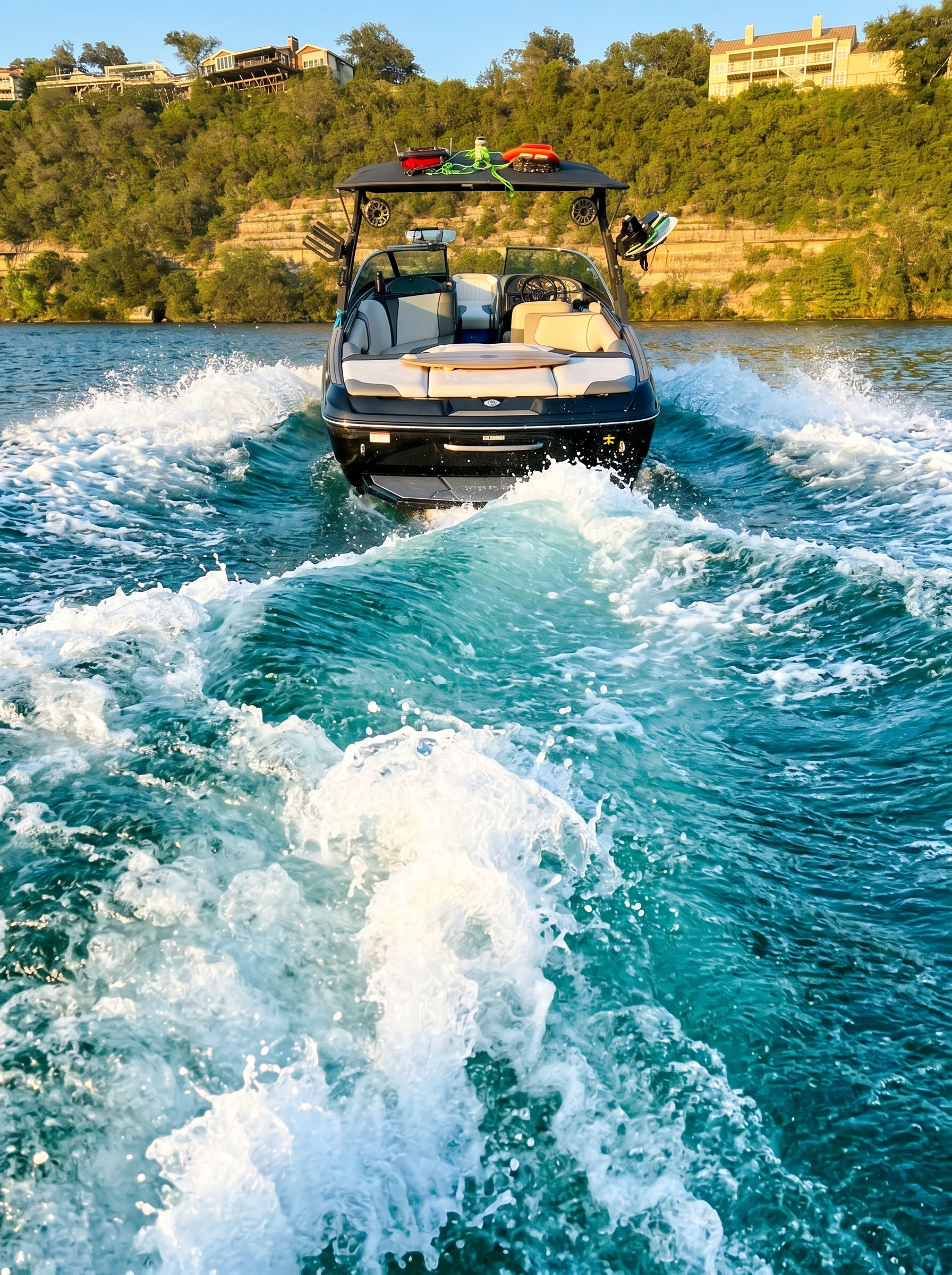
What boats are safe to wakesurf behind?
Wakesurf only behind a boat specifically designed and approved by its manufacturer for wakesurfing, with a propulsion layout that keeps the propeller away from the rider’s normal surfing area. Purpose-built inboard wakesurf boats are the standard example. Certain forward-facing sterndrive installations are also designed for wakesurfing, but approval must apply to the actual boat-and-drive combination.
Do not wakesurf behind a conventional outboard or rear-facing sterndrive. Their propellers sit near the stern, where a wakesurfer can approach during a fall or an unexpected surge forward.
No boat makes wakesurfing risk-free. A suitable propulsion system is only the starting point: exhaust exposure, loading, water depth, traffic, rider supervision, and pickup procedures all matter.
Why wakesurfing requires a different boat than wakeboarding
In wakesurfing, the rider uses the boat’s wave for propulsion and usually rides close behind the transom after releasing a short tow rope. The transom is the rear structural face of the hull.
Wakeboarding typically uses a longer tow rope, keeping the rider much farther behind the boat during normal riding. A boat suitable for towing a wakeboarder is therefore not automatically suitable for wakesurfing.
Three features deserve separate evaluation:
- Propulsion layout: Where are the propeller, drive hardware, and other underwater hazards?
- Wakesurfing approval: Does the manufacturer permit wakesurfing with this exact configuration?
- Operating setup: Can the boat carry its passengers and ballast within its limits while maintaining visibility and control?
A surf tower, board rack, large swim platform, or impressive-looking wake does not answer those questions.
Boat types and wakesurfing suitability
| Boat or propulsion type | Wakesurfing suitability | Key consideration |
|---|---|---|
| Purpose-built inboard wakesurf boat | Generally suitable when operated as specified | Propeller is underneath the hull, forward of the transom; other hazards still require management |
| Older direct-drive or V-drive inboard | Requires model-specific verification | An inboard layout alone does not establish wakesurfing approval, loading limits, or suitable exhaust arrangements |
| Conventional outboard boat | Not suitable for close-following wakesurfing | Motor and propeller are at or behind the transom |
| Conventional rear-facing sterndrive | Not suitable for close-following wakesurfing | Exposed propulsion hardware occupies the area behind the stern |
| Forward-facing sterndrive surf configuration | May be suitable if specifically approved | Verify the complete boat-and-drive installation, not just the drive’s name |
| Jet-powered boat | Do not assume suitability | Lack of an exposed propeller does not resolve jet discharge, exhaust, or manufacturer restrictions |
What is an inboard boat?
An inboard has its engine inside the hull and typically drives a propeller through a shaft passing through the hull. On common wakesurf configurations, the propeller sits underneath the boat rather than projecting behind the transom.
A direct-drive configuration generally places the engine farther forward, with power transmitted toward the stern. A V-drive typically places the engine near the stern and uses a transmission arrangement that redirects the driveline.
Both are inboards, but their weight distribution and intended uses can differ. Do not assume that every older ski boat can safely accept enough added ballast to create a surfable wave.
What makes a forward-facing sterndrive different?
A conventional sterndrive has rear-facing propellers behind the transom. A forward-facing surf drive places its propellers toward the bow, underneath the boat’s stern area.
That distinction matters, but it is not a blanket approval for every installation. The boat must be designed and approved for wakesurfing with that drive, including its platform, exhaust arrangement, controls, and operating instructions.
If you cannot establish the exact configuration, do not use the boat for wakesurfing until it has been verified.
Step 1: Verify the boat before adding ballast
Start with documentation, not a test ride.
- Identify the boat’s year, make, model, and propulsion system. Similar-looking models may have different drives or approved activities.
- Read the owner’s manual and activity warnings. Look specifically for wakesurfing guidance, passenger placement, loading limits, and exhaust warnings.
- Confirm unfamiliar configurations with the manufacturer or an authorized dealer. Ask about the exact boat and drive combination.
- Review modifications. Added ballast, aftermarket platforms, exhaust changes, and wave-shaping devices can affect safe operation.
- Check the boat’s condition. Steering, throttle response, engine shutoff controls, boarding access, and factory surf systems must work as intended.
A seller’s statement that a boat “throws a great surf wave” is not a substitute for manufacturer guidance. Neither is a video showing someone surfing behind the same model.
For a captained outing, guests can ask what boat is used and how the operator manages rider supervision and pickup. Texas Wakesurf Charters provides boat information on its vessel page.
Step 2: Understand what ballast can and cannot do
Ballast is weight carried to change how the hull sits in the water. Wakesurf boats commonly use built-in water tanks or approved bags to increase displacement and help shape the wave.
A surf system uses devices such as tabs or gates to alter water flow and help form the wave on the selected riding side.
Neither ballast nor a surf device makes an unsuitable propulsion system safe.
Start with the manufacturer’s baseline
Use the boat’s specified surf settings and loading instructions before making changes. Account for passengers, gear, fuel, and ballast according to the manufacturer’s guidance. Do not treat a maximum-person rating as permission to add unlimited water weight.
Too much weight, or weight concentrated in the wrong place, can:
- Reduce freeboard, the height between the waterline and the upper edge of the hull.
- Increase the chance of taking water over the bow or stern.
- Obstruct the driver’s forward view.
- Change steering, acceleration, and stopping behavior.
- Make a low-speed turn or an encounter with another boat’s wake more hazardous.
Passengers should remain in designated seating positions. Do not ask people to sit on the transom, swim platform, gunwales, or other unapproved areas to improve the wave.
Change one setting at a time
When adjustment is permitted, change only one variable at a time: an approved ballast setting, surf-system setting, or speed adjustment within the manufacturer’s guidance. This makes the result easier to evaluate.
There is no universal ballast recipe or surf speed that fits every hull. If a clean wave requires exceeding limits or compromising visibility, stop rather than continuing to add weight.
Step 3: Manage exhaust and carbon monoxide exposure
Propeller placement does not eliminate exhaust risk. Gasoline engines produce carbon monoxide, a poisonous gas that cannot be seen or smelled. Exposure can occur outdoors, especially near the stern and swim platform.
Airflow, boat speed, wind, loading, and nearby running engines can influence where exhaust accumulates. Exhaust-routing equipment may reduce exposure in some operating conditions, but it does not make the stern area safe for unrestricted occupancy.
Use these precautions:
- Never allow platform riding or holding onto the swim platform while the engine is running.
- Keep swimmers and waiting riders away from the stern of a running boat.
- Shut the engine off before a rider approaches the platform to board.
- Avoid unnecessary idling around people in the water.
- Follow all manufacturer exhaust warnings, including restrictions on rear seating.
Headache, dizziness, nausea, weakness, or confusion can indicate carbon monoxide exposure. Do not dismiss those symptoms as ordinary fatigue. Stop the activity, move the affected person to fresh air without exposing others, and call 911 if poisoning is suspected. Do not let an impaired person swim unassisted.
Step 4: Establish a controlled rider routine
A suitable boat still needs a consistent operating procedure. Before the first pull, the captain should explain signals, starting instructions, rope handling, and what happens after a fall.
Before moving
- Fit the rider with an appropriately approved, properly fitting life jacket.
- Use a wakesurf-specific rope and inspect it for damage.
- Keep rope loops away from hands, feet, and the body.
- Assign a designated observer to watch the rider and communicate with the captain.
- Confirm that passengers are seated and the rider is clear of the boat.
- Check the surrounding water for swimmers, boats, obstacles, and floating debris.
An observer supports supervision but does not relieve the operator of responsibility for navigation or applicable legal requirements.
During the ride
Use smooth, predictable inputs. Keep the route clear of docks, shoreline activity, anchored boats, and other water users. If traffic or visibility makes a straight, controlled pass impractical, end the pull.
Once the rider releases the rope, retrieve it promptly when safe. A loose rope can entangle a rider or enter propulsion equipment.
After a fall
Reduce power in a controlled manner and keep the rider in sight. Avoid abrupt high-speed turns that send additional wake through the area.
Approach slowly with continuous communication between operator and observer. Do not reverse toward a rider. Position the boat for pickup, then shut the engine off before the rider approaches the platform or boarding area. Neutral alone is not a substitute for shutting the engine off during boarding.
Step 5: Recheck the operating area on Lake Austin
Even with an appropriate boat, not every stretch of water is suitable for a surf pass.
On Lake Austin, evaluate conditions where you intend to operate rather than assuming the whole lake has the same depth, traffic, or exposure. Watch for posted restrictions, docks, shoreline structures, shallow areas, floating debris, and concentrated recreational traffic.
Depth affects both underwater clearance and wave formation. Use the boat manufacturer’s depth guidance and reliable navigation information. Do not move closer to shore simply to chase a different-looking wave.
Large wakes can affect people and property beyond the rider’s immediate path. Leave generous space and change locations when your wake could create a hazard. A clear lane in front of the boat does not necessarily mean the wake has a clear path to shore.
For local planning context, see the Lake Austin guide. Confirm current restrictions and conditions before departure; a general guide cannot replace posted notices or the captain’s real-time judgment.
A practical checklist for choosing a wakesurf outing
Before committing to a boat or booking, confirm these essentials:
| Question | What to look for |
|---|---|
| Is this exact boat approved for wakesurfing? | Model-specific manufacturer guidance |
| How are people kept clear of propulsion hardware? | Suitable drive layout and engine-off boarding |
| Who watches the rider? | Clear operator and observer responsibilities |
| How is loading controlled? | Approved ballast settings and designated seating |
| How is exhaust exposure addressed? | No platform riding and minimal idling near swimmers |
| What happens if conditions deteriorate? | A willingness to pause, relocate, or stop |
Texas Wakesurf Charters offers captained private wakesurf and lake-day charters on Lake Austin in Austin, Texas. Included are an expert captain and water sports instructor, fuel, top-tier water sports equipment, and a complimentary cooler with ice. A mandatory 20% gratuity is due to the captain.
Review pricing and available experiences to choose the appropriate outing. Public wake surf sessions are shared sessions, not private charters.
For a captained Lake Austin outing, book a charter.
Frequently asked questions
Can you wakesurf behind an outboard boat?+
Do not wakesurf behind a conventional outboard. Its motor and propeller occupy the stern area where a close-following wakesurfer could approach during a fall or surge forward. A large swim platform or added surf device does not remove that hazard.
Are all inboard boats suitable for wakesurfing?+
No. An inboard's propeller location is an important design feature, but the boat must also be approved for wakesurfing and operated within its loading and equipment limits. Verify older ski boats and modified boats individually.
Can you wakesurf behind a forward-facing sterndrive?+
Certain forward-facing sterndrive configurations are designed for wakesurfing. Confirm that the manufacturer approves the exact boat-and-drive combination, and follow its operating, loading, exhaust, and boarding instructions.
Does adding ballast make a boat safe for wakesurfing?+
No. Ballast changes hull displacement and wave characteristics, not the fundamental safety of the propulsion layout. Excessive or poorly distributed ballast can reduce freeboard, obstruct visibility, and compromise handling.
Should the engine be off when a wakesurfer boards the boat?+
Yes. After a controlled pickup approach, shut the engine off before the rider approaches the swim platform or boarding area. Neutral alone does not provide the same protection, and a running engine also creates exhaust exposure.
Is carbon monoxide a concern on an open wakesurf boat?+
Yes. Carbon monoxide from engine exhaust can expose people outdoors, particularly near the stern and swim platform. Avoid unnecessary idling near swimmers, prohibit platform riding, and treat suspected poisoning as an emergency.
Ready to ride?